
.png&w=1920&q=75)


Today, enterprise system protection is not optional. Of these systems, SAP sits at the center of operations, finance, and supply chain. But what guards it? Welcome to SAP Cyber Security, the world of your digital defense for enterprise resilience.
SAP Security isn’t a technical to-do item; it’s a strategic necessity. With high-profile attacks now frequently targeting ERP systems, leveraging SAP Security, SAP Authorization, SAP Access Control, and SAP Security Monitoring is no longer a choice; it’s a requirement.
What Is SAP Cyber Security?
SAP Cloud Security is the proactive shield that protects mission-critical data and processes within an SAP environment. This layer of security encompasses everything from network protocols to access controls, ensuring the maintenance of confidentiality, integrity, and availability (CIA triad). It’s not a tool; it’s a comprehensive strategy that includes infrastructure, application code, access controls, and ongoing monitoring.
Highly regulated industries, like healthcare and finance, depend on SAP Cyber Security controls to ensure compliance and avoid fines. Moreover, it prevents insider attacks and misconfigurations—prevalent yet underappreciated vulnerabilities.
How Does SAP Security Work?
Strong SAP Security is constructed like a fortress, layered, dynamic, and robust. Here’s how each pillar adds to overall resilience:
1. Secure Configuration & Infrastructure
SAP systems need to be hardened at OS, database, web server, and application levels. Secure defaults, encryption through SSL/SNC, and rigorous patching are not negotiable.
SAP Cryptographic Library and HTTPS guarantee that data stays secure in transit—no open doors for hackers.
2. Functions, Authorizations & SAP Access Control
SAP access control is role-based (RBAC), with SAP Authorization as its foundation. Users are arranged into roles that convey specific transaction privileges—nothing less, nothing more.
Segregation of Duties (SoD) avoids conflicts, for example, a person creating a vendor shouldn’t be able to approve payments. Both static and dynamic SoD are essential checks.
3. Secure Code & ABAP Security
Custom ABAP code needs to be checked for flaws—code injection, insecure processing of user inputs, or weaknesses in third-party libraries.
Tight development processes guarantee production systems only execute sanctioned, secure code.
4. SAP Security Monitoring & Logging
The transformation journey is an exhilarating experience for your business. But the real excitement comes when you can dream big, move at lightning speed, and innovate faster than ever before.
You can opt for AWS, Azure, Google Cloud or SAP DC to quickly adapt to market changes. Cloud offers agility to scale operations up or down as needed. It makes it possible to experiment, adjust, scale, personalize, and fly with a freedom that’s simply not possible with on-premise ERP. And with no need for large capital investments in hardware or IT infrastructure, it follows a clean core approach to take maximum benefit of the latest cloud innovations.
What Are the Major Components of SAP Security?
User Authentication and Access Control
Security in SAP begins with authenticating users and controlling access through role-based controls to prevent unauthorized access to high-value systems.
Identity and Access Management (IAM)
IAM solutions simplify user provisioning and implement least-privilege access, which ensures users can only access what they require.
Data Encryption and Secure Communication
Encryption protects data at rest as well as in transit, while secure protocols protect communication between SAP systems.
Compliance and Governance
Solutions such as SAP GRC assist in enforcing policies, managing risk, and staying audit-ready.
SAP and Cyber Security Integration
Threat detection, vulnerability management, and incident response bring SAP and cyber security into harmony for end-to-end enterprise protection.
What are the Common Threats to SAP systems?
SAP RISE is subscription-based, which means from CapEX to OpEx, there is a predictable cost. In simpler terms, you pay for what you use with pay-as-you-go pricing models. Instead of paying upfront for SAP S/4 HANA licenses and infrastructure, you can save on overall IT costs. You pay a monthly or quarterly fee that comprises everything from cloud hosting to hardware upgrades, physical server maintenance, cooling, and power and disaster recovery infrastructure.
How Can Organizations Secure Their SAP Systems?
Organizations can strengthen SAP security through role-based access controls, patching regularly, secure setup, and ongoing monitoring. Employing tools such as SAP GRC, data encryption, and the integration of cybersecurity best practices enhances defenses. Ongoing audits and employee training are also crucial to achieving strong SAP security throughout the enterprise.
Enterprise Security Framework
The framework made by the National Institute of Standards and Technology (NIST) defines five foundational pillars intended to assist private sector organizations in effectively managing digital risk. The pillars act as a blueprint for the implementation of best practices to enhance an organization’s overall security stance. When enforced uniformly and simultaneously, they facilitate the development of an effective and resilient defense strategy.
The pillars include:
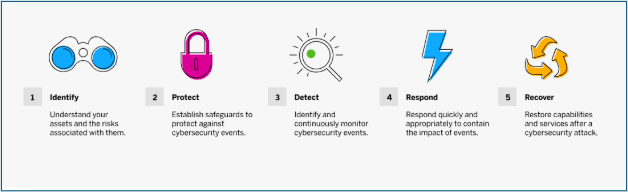
Why SAP Systems Need Strong Cyber Security?
1. Fraud Prevention & Data Integrity
Without SAP Access Control, insiders or outside parties can alter invoices, financial statements, or supply chain transactions. Proper authorization ensures that sensitive processes are securely locked down.
2. Regulatory Compliance
Governance, from GDPR to SOX, requires tight controls on who can see what and traceability for when they do so. SAP Authorization supports meeting those requirements with complete audit trails.
3. Business Continuity
An SAP system that is compromised would lead to a supply chain collapse or HR freeze. Strong SAP cybersecurity, including network hardening, backups, and monitoring, avoids downtime and secures revenue.
4. Unified Enterprise Defense
SAP is far too important to be isolated. Folding its logs into an enterprise SOC through SAP Security monitoring ensures it’s included in the overall cybersecurity matrix.
5. Governance, Risk, and Compliance
SAP GRC Suite provides a single framework for access control management, Segregation of Duties enforcement, and audit compliance, making it a must-have for companies prioritizing governance, risk management, and regulatory compliance.
What is the Difference Between SAP Cyber Security and SAP Security?
| Aspect | SAP Security | SAP Cyber Security |
|---|---|---|
| Focus | Manages access, roles, and authorizations within SAP applications | Protects SAP systems from external cyber threats and attacks |
| Scope | Internal controls, user provisioning, and compliance | Network security, threat detection, vulnerability management |
| Tools Used | SAP GRC, SU01, PFCG | Firewalls, SIEM, SAP Enterprise Threat Detection |
| Primary Goal | Ensure secure, compliant access to SAP systems | Prevent data breaches, malware, and unauthorized access to the SAP environment |
| Responsibility | SAP functional and security administrators | IT and cybersecurity professionals |
SAP Security Tools & Solutions
SAP security solutions and tools comprise SAP GRC for governance, SAP Identity Management for user administration, SAP Enterprise Threat Detection for monitoring threats in real-time, and SAP Cloud Identity Services for secure authentication.
Best Practices for SAP Security
Map Your Roles & Authorizations
- Begin by establishing system roles along with job functions (RBAC).
- Utilize SoD tools to discover separation gaps—automated prevention avoids problems before they occur.
Enforce Security‑by‑Design
- Instill security early in projects—design, development, and rollouts.
- Track custom ABAP with automated scans and peer reviews.
Audit & Harden System Configuration
- Implement SAL and have stringent password policies.
- Utilize SAPnotes and tools such as the SAP Solution Manager for proactive checks.
Centralize Monitoring & Incident Response
- Forward logs to a Security Operations Center (SOC) with SIEM protection.
- Utilize real-time alerts for suspicious behavior through SAP security monitoring tools.
Patch & Update Religiously
- Maintain SAP security notes and examine and implement them promptly.
- Treat based on urgency and thoroughly tested before deployment.
Why Korcomptenz Is Your Ideal SAP and Cyber Security Partner?
With more than 20 years of ERP implementation experience, Korcomptenz has always enabled business houses with end-to-end transformation solutions that meet their specific requirements. Our in-depth expertise in industries such as manufacturing, retail, automotive, pharmaceuticals, and CPG guarantees domain-specific insights, along with accelerated time to value.
We provide an effortless transition to S/4HANA, supported by a proven history of successful SAP implementations and migrations. We are well-versed in contemporary solutions such as RISE with SAP and GROW with SAP, providing the flexibility required to succeed in changing markets. We also offer cutting-edge capabilities in Supply Chain Planning using SAP IBP, enabling clients to ensure operational continuity and minimize disruptions.
As an established SAP on Azure partner and Direct CSP for AWS, Korcomptenz facilitates cloud-native transformation with unparalleled scalability. From integrating legacy systems to adapting modules to accommodate intricate needs, our experience in SAP customization and integration makes us a go-to digital transformation partner.
Key Takeaways
- SAP Security is mandatory, not discretionary, securing core enterprise processes in finance, operations, and supply chain.
- Its comprehensive security strategy entails configuration hardening, role-based access control, secure coding, and real-time monitoring.
- Regulatory compliance and business continuity are highly dependent on proactive SAP cyber protection.
- Including SAP in your enterprise SOC ensures centralized threat detection and accelerated incident response.
- Engaging a domain-qualified provider such as Korcomptenz ensures customized, scalable, and future-proof SAP cybersecurity.
Final Thoughts
The future of SAP cybersecurity in the US is automation, zero-trust models, and more stringent compliance. Enterprises need to take a route to modernization to remain secure and resilient against emerging threats.
Ready to secure your SAP landscape? Let Korcomptenz collaborate with you for a customized SAP Security audit.
Secure your SAP systems with confidence. Partner with Korcomptenz for tailored cybersecurity solutions.


