


QuickBooks Enterprise can take a growing business a long way. But as operations expand, the challenge is no longer just accounting. Finance has to connect with inventory, purchasing, manufacturing, sales, projects, and service. That is where the ERP question begins. The trigger is usually not company size alone. It is the point where transaction volumes, entities, inventory, reporting, controls, or operational dependencies become difficult to manage across disconnected systems.
If teams increasingly depend on spreadsheets, additional applications, duplicate data entry, and manual handoffs, the issue is not whether QuickBooks Enterprise still works. It is whether the business is beginning to need more than an accounting centered platform.
Microsoft Dynamics 365 Business Central changes that equation. It brings finance and operations together on a cloud ERP platform and is now evolving further with Copilot, automation, and AI agents that can increasingly take on parts of everyday work.
For growing organizations, that makes the move to Business Central a broader technology and business decision than it was a few years ago.
When QuickBooks Enterprise Is No Longer Enough
The case for ERP becomes stronger when business complexity starts to outgrow an accounting-led technology environment. More entities, transactions, reporting demands, operational dependencies, and control requirements create a need for tighter coordination across finance and operations.
At that stage, the question is no longer what the accounting system can handle in isolation. It is whether the wider technology environment can support the business as one connected operation.
Connected Decisions Across the Business
Business Central creates a shared operational view across the decisions that shape performance. Sales can work with current inventory and fulfillment information, purchasing can respond to demand, and production can align materials, schedules, and costs more closely.
Finance gains earlier visibility into how those decisions affect revenue, margin, cash flow, and working capital. Instead of assembling the picture after the fact, leaders can work from information connected across the business.
Business Central Within the Wider Microsoft Ecosystem
Business Central also sits within the broader Microsoft ecosystem. Depending on business complexity, organizations may use Business Central alongside CRM, analytics, automation, and productivity tools, or determine that Dynamics 365 Finance and Supply Chain Management is a better ERP fit for more complex enterprise requirements. These include:
- Dynamics 365 Finance and Supply Chain Management for more complex finance, manufacturing, and supply chain requirements
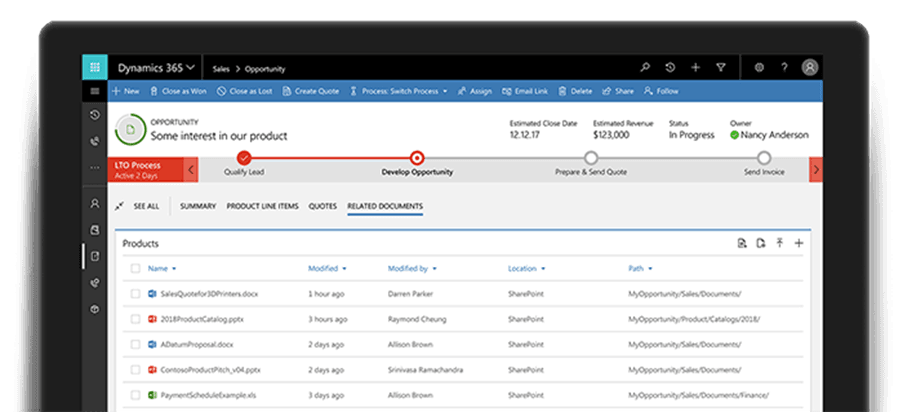
- Dynamics 365 Sales for deeper sales and opportunity management
- Dynamics 365 Customer Service for more advanced customer service operations
The strategic value is a Microsoft platform that can scale ERP, CRM, analytics, automation, and AI as business needs evolve.
AI Is Changing What Business Central Can Do
The next shift is already underway.
Copilot can assist users with analysis and everyday activities inside Business Central, while Microsoft is expanding autonomous agents that can take responsibility for defined parts of business processes.
The Sales Order Agent, for example, can support order handling from customer requests. The Payables Agent can work with incoming vendor invoices and help prepare transactions for review.
ERP is beginning to move beyond recording and coordinating work toward helping execute defined parts of it. For leaders, the value is not simply more automation. It is whether these capabilities reduce manual effort, shorten cycle times, improve control, and allow teams to focus on exceptions and higher-value decisions.
Capabilities That Extend Beyond Accounting
Business Central provides broader operational and management capabilities that become increasingly valuable as the organization grows. These include:
- Financial management with budgeting, dimensions, cash flow, consolidation, and financial reporting
- Supply chain and inventory management across purchasing, sales, inventory, warehousing, and fulfillment
- Manufacturing and production management including production planning, bills of material, routings, capacity, costing, and subcontracting, with additional quality requirements supported through configuration, extensions, or industry solutions where needed.
- Project and service management to manage projects, resources, costs, billing, service orders, and ongoing service requirements.
- Workflow and approval management to bring greater control and consistency to business processes.
- Role based security and permissions to manage access based on user
- Reporting and analytics with built in analysis capabilities and Power BI integration
- Copilot and AI agents that increasingly support analysis, automation, and transaction processing
Moving Beyond QuickBooks Is a Business Decision
The ERP decision is no longer about adding functionality. It is about choosing a platform that can support greater operational complexity and future business needs.
Dynamics 365 Business Central brings finance, operations, analytics, automation, Copilot, and emerging agent capabilities into a more connected business environment. The right decision still depends on operational complexity, transaction volumes, manufacturing requirements, global operations, integrations, and the level of control the business needs. For some organizations, Business Central is the natural step beyond QuickBooks; for others, a more complex ERP may be appropriate. For leaders, the opportunity goes beyond replacing an accounting system. It is about creating a platform that can support how the business evolves.
Plan the Move with Korcomptenz
Korcomptenz supports organizations across Business Central assessment, migration, implementation, integration, customization, support, and optimization. Our migration experience spans QuickBooks, Dynamics GP, NAV, SL, Sage, Epicor, NetSuite, and Infor, bringing knowledge of both legacy ERP environments and Business Central.
It also brings proprietary Business Central accelerators designed around industry and process requirements, helping organizations extend the platform where standard capabilities need to go further. Combined with our capabilities across automation, AI, Microsoft Fabric, Azure, and the wider Microsoft ecosystem, this helps create a Business Central environment designed for both immediate requirements and what comes next.
Ready to Move Beyond QuickBooks Enterprise?
See how Korcomptenz can help you assess, plan, and move to Dynamics 365 Business Central.