SAP Exit Readiness Assessment | Evaluate ERP Transition Strategy
Assess your readiness to exit SAP with Korcomptenz’s SAP Exit Readiness Assessment. Evaluate risks, costs, data migration, and alternative ERP options to plan a smooth transition.
Most ERP advisory starts with a preferred outcome. SAP partners recommend SAP. Dynamics partners recommend Dynamics. The advice is only as objective as the advisor's experience — and most firms have only ever worked on one side.
Korcomptenz has delivered SAP S/4HANA implementations, SAP ECC to Dynamics 365 migration programs, and Microsoft Dynamics implementations, including Dynamics 365 Finance & Supply Chain Management.. We know how both systems handle the business problems that matter to growing companies: multi-entity finance, supply chain complexity, regulatory compliance, and integration at scale. That dual experience is what makes our platform advisory credible — and it is why companies at the crossroads bring us in.

20+
Accredited
Direct CSP
Specialists
Altiaris
SAP ECC support ends in 2027. Plan ahead.

Rising maintenance costs
Keeping SAP ECC beyond 2027 can consume more budget through support, aging infrastructure, and complexity, leaving less room for modernization and innovation.

ABAP customization debt
Years of ABAP workarounds can turn custom code into a modernization constraint, increasing upgrade complexity and making SAP harder to evolve.

Complex integrations
Point-to-point integrations and legacy middleware create growing system dependencies, slowing change, increasing complexity, and making SAP modernization harder to manage.

Limited AI readiness
ECC was not designed for embedded AI and agentic capabilities, making intelligent automation and autonomous workflows harder to scale enterprise-wide.
Upgrade challenges
S/4HANA migration is more than a technology upgrade. Data, customizations, integrations, and process redesign can increase costs and extend timelines.
Support growth across entities, regions, products, and business models.
Bring ERP closer to Microsoft 365, Teams, Power BI, Power Platform, Fabric, Copilot, and Azure AI.
Enable intelligent workflows, forecasting, approvals, exception alerts, automation, and real-time decision-making.
Standardize core processes, reduce unnecessary customizations, and extend where differentiation matters.
The honest platform assessment — what we look at
Before recommending S/4HANA or Dynamics 365, we run every option through the ERP fit assessment, measured against your data, not our preference.
Process Fit
Where each platform handles your core workflows natively versus requiring customization or add-ons.
Scale Fit
How each platform performs as you add entities, countries, users, and transaction volume.
Compliance Fit
Regulatory requirements (FDA, GxP, HIPAA, SOX) that one platform handles more natively.
Integration Fit
Your existing technology ecosystem and how each ERP connects to it.
Total Cost of Ownership
Not just licensing, but implementation, customization, support, and upgrade cost over 5–7 years.
Migration Complexity
If you are moving from an existing ERP, what the migration to each platform actually involves.
Not every organization requires the scale and sophistication of SAP S/4HANA. If your business operates with simpler processes and relies heavily on the Microsoft ecosystem, Dynamics 365 Finance and Supply Chain Management may deliver greater value with less complexity. We prioritize long-term business outcomes over software preferences.
| Dimension | SAP ECC Reality | Dynamics 365 F&SCM Advantage |
|---|---|---|
| Architecture | Monolithic and customization-heavy | Cloud-native, modular, and configuration-first |
| Cost model | Rising support, custom code, and integration costs | More predictable cloud operating model |
| AI readiness | Often requires bolt-ons or added integration | Built for Copilot, Azure AI, Power Platform, and Fabric |
| Reporting | Siloed data and delayed visibility | Connected analytics through Power BI and Fabric |
| Upgrades | Disruptive and costly | Lower-disruption continuous innovation |
| User experience | Legacy workflows and interfaces | Modern Microsoft experience |
| Integration | New capabilities add cost and risk | Microsoft ecosystem connectivity |
| Scalability | Expansion often requires customization | Repeatable templates across entities and geographies |
| TCO Driver | SAP ECC Cost Pattern | Dynamics 365 F&O Cost Pattern |
|---|---|---|
| Platform run cost | Infrastructure, support, and maintenance overhead | Subscription-based cloud operating cost |
| Customization | High effort to maintain custom code and reports | Configuration-first with selective extensions |
| Integration | Added effort for analytics, automation, and AI | Microsoft ecosystem reduces friction |
| Upgrades | Higher testing and disruption risk | Continuous updates and evergreen optimization |
| Reporting | Manual extraction and reconciliation | Power BI, Fabric, and embedded analytics |
| Process change | Heavier development and testing | Agile workflows through Power Platform |
| AI enablement | Requires bolt-ons or additional integration | Built-in path to Copilot, Azure AI, and automation |
If the assessment points to SAP S/4HANA, we run the migration. Our Dynamics experience means the data mapping, process redesign, and integration re-engineering are led by people who understand your source system from the inside. There is no learning curve on your project timeline.
2-week migration readiness assessment — source ERP mapped, lane recommended, business case built.
RISE with SAP for complex brownfield or multi-entity environments.
GROW with SAP for clean-slate or new-entity implementations.
Altiaris deployed at go-live — so leadership has live SAP intelligence from day one.
Driving integrated ERP operations across 50 countries with secure access, seamless connectivity, and dependable global support.

Improving asset uptime, material visibility, and cost control across maintenance-intensive manufacturing.
Our SAP ECC to Dynamics 365 Readiness Assessment helps define the business case before committing to migration.
You receive:
Korcomptenz helps enterprises modernize ERP with the right balance of platform expertise, industry process understanding, and value-led execution. We bring:
Dynamics 365 Finance & Supply Chain Management expertise
SAP ECC migration and modernization experience
Finance, supply chain, manufacturing, distribution, retail, and healthcare process knowledge
Data, analytics, AI, and integration capabilities across the Microsoft ecosystem
Assessment-led migration planning
Business Value Register to track ROI
Phased delivery to reduce risk and accelerate value
Assess your readiness to exit SAP with Korcomptenz’s SAP Exit Readiness Assessment. Evaluate risks, costs, data migration, and alternative ERP options to plan a smooth transition.

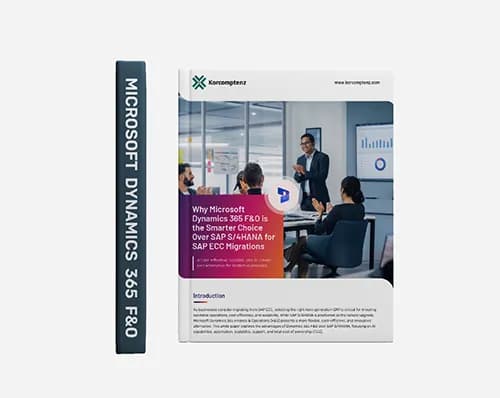
Explore why Microsoft Dynamics 365 Finance & Operations is the smarter, cost-effective, and future-ready choice for SAP ECC migration.
Migrate from SAP ECC to Microsoft Dynamics 365 Finance & Operations with Korcomptenz. Modernize ERP, reduce legacy costs, and gain real-time insights with a scalable cloud platform.
Dynamics 365 Finance & Supply Chain Management is often a strong fit for organizations seeking modern cloud ERP capabilities, Microsoft ecosystem integration, and lower complexity. A structured assessment helps determine whether it aligns with your operational, compliance, and growth requirements.
Yes, direct migration from SAP ECC to Dynamics 365 is possible, but it typically requires careful planning, data transformation, process mapping, and integration redesign. A phased approach with assessment, fit-gap analysis, and validation ensures reduced risk and smoother transition.
Organizations can gain improved visibility, streamlined operations, cloud scalability, advanced analytics, and tighter integration with Microsoft tools. Dynamics 365 also supports continuous innovation while reducing reliance on aging infrastructure and costly ERP customizations.
Migration timelines depend on process complexity, data volume, integrations, customizations, and organizational readiness. While some projects can be completed within months, larger multi-entity environments typically require a phased approach to reduce risk and disruption.
Risk is reduced through detailed assessments, migration planning, data validation, testing, change management, and phased deployment strategies. Establishing clear business objectives and governance frameworks helps ensure a smoother transition with fewer operational disruptions.
Organizations typically achieve greater operational agility, faster reporting, improved supply chain visibility, lower IT complexity, and enhanced decision-making. Dynamics 365 also provides a scalable foundation for growth, innovation, automation, and long-term digital transformation initiatives.
SAP ECC migration cost varies widely based on system complexity, data volume, customizations, integrations, and chosen target platform. Costs typically include assessment, licensing, implementation, testing, change management, and support. A detailed evaluation is required for accurate estimation.