.png&w=1920&q=75)


Introduction
As the world changes, so does the future of our students. We cannot sit back and let them enter a drastically shifting employment market without transforming the pedagogy, culture and approach to technology that is a legacy of the previous century.
Today’s students need real-world skills to thrive in the not-too-distant future. Qualities like critical thinking, collaboration, creative problem solving, self-awareness, self-management, responsible decision-making, and the ability to construct complex solutions. This is true regardless of subject area. Complex skills are as important for artistic, service, and human-oriented professions as they are for more scientific, technological, or industrial employment.
Digital skills are now Vital for All
On top of critical thinking and problem solving, the digital skills that were once the province of computer science students are now crucial across the entire spectrum of education. It’s increasingly difficult to imagine how your students will succeed without digital facility, be they looking to pursue careers in healthcare or banking, academia, or the performing arts. For education systems, this requires a deliberate effort to create conditions where learners can demonstrate and develop these capabilities.
The key is focusing on student centricity
For learning transformation, student centricity should be the core of your ‘disruption.’ This makes it possible to move successfully from a traditional model based on mastery of a curriculum, to a model of learning that is about giving students the practical experience to achieve their personal potential. Our focus has shifted to equipping young people with future-ready skills for jobs that are yet to be invented or which are unlikely to be automated. To ensure that today’s youth have these skills and are employable in the workforce of the future, the 2016 World Economic Forum observed: The education system will need to adapt to prepare individuals for the changing labor market. At the same time, recent IT advances offer new and potentially more widely accessible ways to access education.
A Proven Approach to Transformation - Microsoft 365 Education Framework
Microsoft worked with 130 leading policy makers and academics to evaluate studies of schools, school districts and countries where learning transformation initiatives have made dramatic improvements. The result is an Education Transformation Framework grounded in the latest research into effective policy, leadership, and pedagogy transformation.
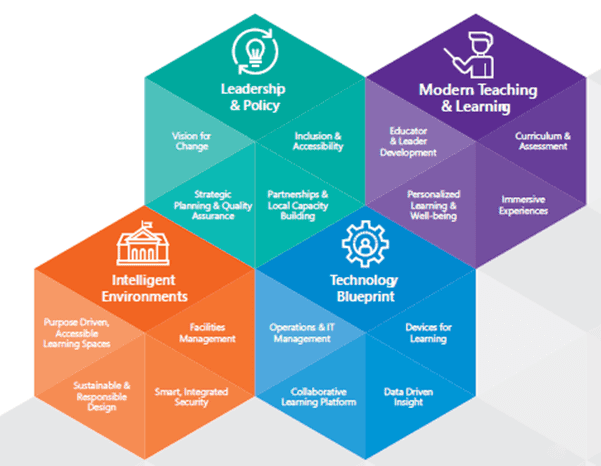
Leadership and Policy
- Vision for Change: It’s about developing a clear, succinct vision to drive change. By creating a rationale that’s shared by leaders and other stakeholders, you can create the momentum for long-term impact.
- Strategic planning and quality assurance: It’s about taking a program management approach Start with an effective plan to achieve multiple workstreams. Include quality assurance metrics and establish a strong governance model.
- Partnerships and local capacity: It’s about partnering with public and private organizations in a long-term strategy. Partners can help build capacity, whether through digitizing administration and management or upgrading staff skills.
- Inclusion & Accessibility: It’s about supporting social inclusion through making technology more accessible, both through customized interfaces and tools for students with special needs and by embedding supports in teacher training.
Modern Teaching and Learning
- Educator and leader development: It’s about professional learning that’s more inspiring than traditional trading. By participating in an active community of practice that shares ideas, successful strategies and content, educators motivate each other to grow and adapt.
- Personalized learning and wellbeing: It’s about new approaches and tools. These help educators unlock students’ sense of purpose and inspire them to achieve more. At the same time, students develop important 21st century competencies.
- Immersive Experience: It’s about taking students vividly outside their own experience.
- Curriculum and Assessment: It’s about creating multifaceted learning content for students—and evaluating them on competencies, not content recall. And it’s about linking them to the community for education, employment, and entrepreneurship.
Intelligent Environments
Purpose-driven, accessible learning spaces: It’s about matching physical learning spaces and furniture with learning goals to provide flexible learning choices. One strategy is to build learning labs and studios next to common, quiet, and collaborative spaces. A low-fi approach is to split existing spaces into specialized zones.
Sustainable and responsible design: It’s about creating healthy, thriving environments with plenty of fresh air, light and natural views to keep learners alert, positive and engaged while reducing costs and environmental footprint.
Smart integrated security: It’s about using intelligent safety systems to proactively make schools safer and reduce bullying and other threats. Such systems can track people and assets, alerting the school community to safety issues. They can also control access to school facilities dynamically, aiding emergency response.
Facilities Management: It’s about using the Internet of Things (IoT), the cloud and data analytics to manage complex school environments more efficiently. Connect digital whiteboards, computers, vehicle fleets, lighting, climate control, parking, security and more to improve visibility of assets while using automation and analytics to save cost.
Technology Blueprint:
- Operations and IT: It’s about creating an agile, flexible and responsive operations and IT environment. Your aim is to put in place a platform and applications that serve the needs of every learner, teacher and administrator across your educational system or institution.
- Collaborative Learning Platform: It’s about enabling the next-level collaboration central to modern teaching and learning. The right platform brings together people, learning content and insights. This can make the difference between success and failure for teachers and students.
- Data Driven Insight: It’s about using evidence-based decision making to transform student learning and your education system. There’s no need to turn everyone into data scientists simply offer easy-to-use tools so they can gauge progress and improve.
- Devices for learning: It’s about choosing devices that offer superior value and support for learning. Powerful devices can run real-world software, preparing students for life beyond school, and enable rich 3D learning experiences not available on simple web content and apps.
Conclusion:
Transformation is about more than technology the goal is to enable a complete re-imagining of learning, anytime, anywhere, and to be ruthless in studying and adjusting when and how technology makes things better. The Korcomptenz Campus Management Solution built on Microsoft Dynamics NAV and Dynamics 365 Business Central covers all workflows related to education such as Admission, Academics, Fee Management, Library, Timetable, Alumni, Hostel Management and Fleet.
Our comprehensive solution leverages Dynamics 365 for education to empower institutions with advanced tools for data-driven decision-making, fostering innovation in every aspect of campus management. Contact us to learn more.

ERP modernization creates the most value when it turns complexity into speed, visibility, and control. See how Korcomptenz unified Dynamics 365 Marketing, Event Hub, and Zoom for a nonprofit serving 276,000 scholars across 305 institutions—streamlining event management and driving higher registrations.