.png&w=1920&q=75)


Food and beverage companies operate with a level of complexity that few other manufacturers face. They manage variable-weight inventory, short shelf life, recipe changes, allergen risk, audit-heavy quality processes, retailer compliance rules, trade promotions, cold chain logistics, often all at once. In such a high stakes operating model, ERP decisions in F&B are closely tied to business performance. The right platform helps address the operational complexities of this fast-growing industry and support uninterrupted movement of goods across the supply chain.
This is where Microsoft Dynamics 365 F&SCM stands out as a strong enterprise foundation. It provides the enterprise-grade finance, supply chain, warehouse, procurement, and production foundation that growing F&B businesses need. More importantly, it brings these capabilities together on a single platform, helping businesses improve control, increase visibility, and respond faster across the value chain.
The Pain Points F&B Businesses Face Every Day
The real ERP challenge in food and beverage is not that core ERP capabilities are missing. It is that the operational realities of the industry demand a level of depth and precision that standard horizontal ERP systems were not designed to deliver.
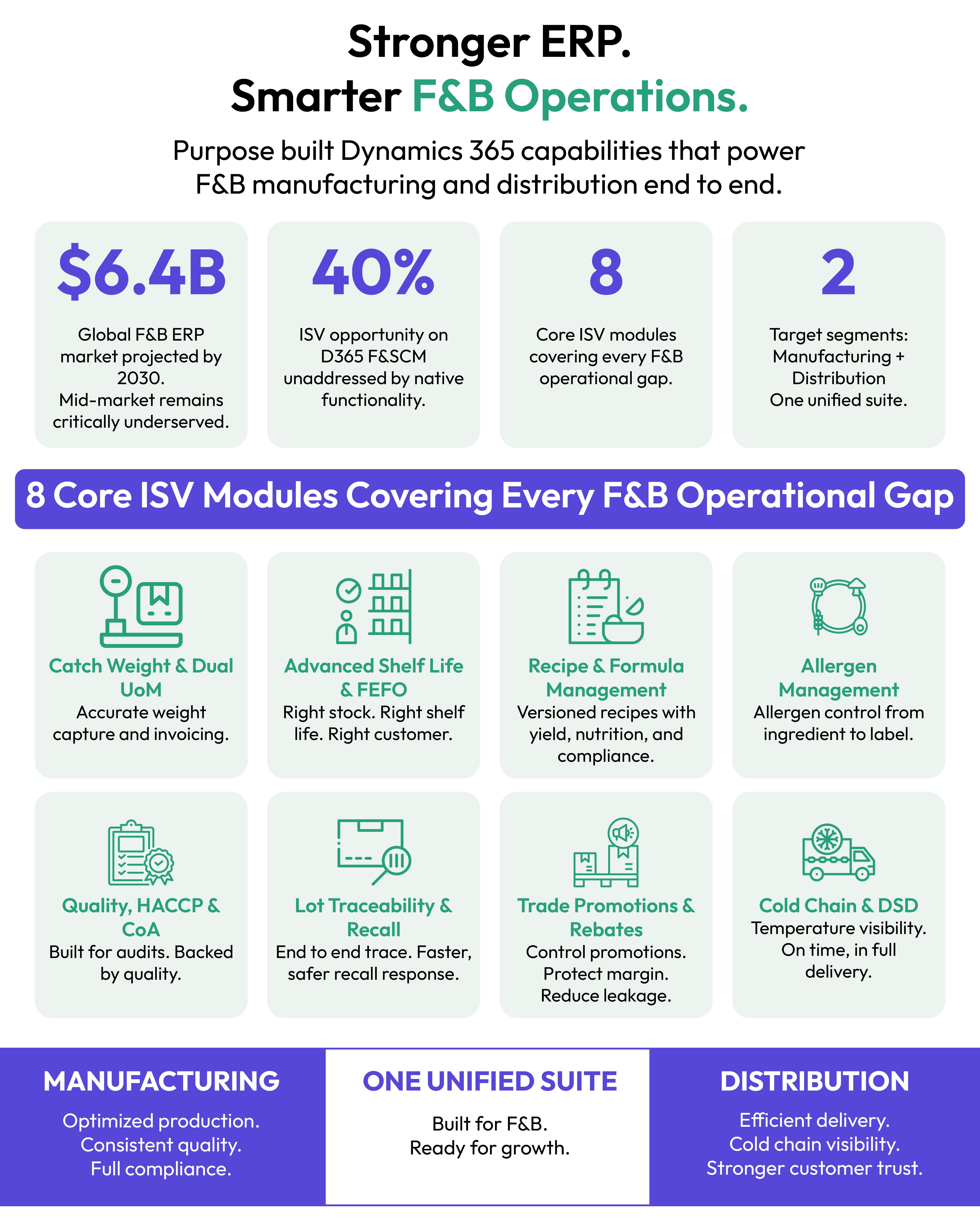
Take catch weight, for example. In categories such as meat, seafood, dairy, and fresh produce, companies buy and sell in one unit but value and invoice in another. A pallet may contain ten cases, but the actual kilograms vary. Without dual unit-of-measure capability, invoice accuracy, inventory valuation, and pricing integrity all suffer.
Then there is shelf life and FEFO management. F&B businesses cannot fulfill orders based only on available stock; they must consider expiration dates, customer-specific minimum remaining shelf life rules, and near-expiry risk. Without that control, businesses increase waste, fail retailer requirements, and absorb avoidable claims and OTIF penalties.
For manufacturers, recipe and formula management is another major gap. A standard BOM is not enough when every formulation change can affect yield, cost, allergens, nutrition panels, and label compliance. The same is true for allergen management, where ingredient-level changes must flow through to scheduling, quality, and labeling to prevent costly errors and reduce recall risk.
On top of that, food companies need HACCP-aligned quality processes, lot traceability, recall readiness, trade promotion control, and cold chain visibility. These are not edge requirements. They are daily business needs in modern F&B operations.
Why Microsoft D365 is the Right ERP foundation
Microsoft D365 remains one of the strongest ERP platforms for F&B because it brings together the enterprise backbone companies need: finance, procurement, inventory, production, warehousing, supply chain and customer operations in one Microsoft ecosystem. Its real strength, however, lies in its extensibility.
Food and beverage companies can add the capabilities they need without fragmenting systems, duplicating data, or creating costly integration layers. That means they can stay on a single platform while still supporting the realities of their operations.
In an industry where timing, quality, compliance, and margin are constantly under pressure, that flexibility matters. Microsoft D365 provides the right ERP foundation for food and beverage manufacturers and distributors by combining enterprise scale, operational agility, and platform extensibility in a way that supports both immediate operational needs and long-term growth.
F&B Use Cases Where D365 Delivers Real Value
Consider a fresh or chilled food distributor managing variable-weight products. With the right extension strategy, Microsoft D365 can support dual unit-of-measure inventory, actual-weight invoicing, and tolerance-based reconciliation. That immediately improves invoice accuracy and eliminates manual weight adjustments that often live in spreadsheets today.
For a packaged food manufacturer supplying major retailers, D365 can become the control tower for FEFO picking, customer-specific shelf-life validation, shelf-life-aware allocation, and near-expiry alerting. Instead of simply promising stock, the business can promise stock that is actually compliant for that customer and delivery date. That shifts ERP from a transaction system to a margin-protection system.
For process manufacturers, recipe management becomes far more strategic when D365 supports recipe versioning, yield-adjusted costing, nutritional calculation, and regulatory label validation. Every recipe change can be tracked, costed, assessed for allergen or labeling impact, and linked back to the batches it affected. That is critical for both compliance and commercial decision-making.
For quality and regulatory teams, D365 can support structured quality processes, CoA generation, NCR/CAPA workflows, and retained sample management.. That means food safety processes are not managed outside the ERP in disconnected files and folders. They become embedded, auditable, and operationally actionable.
And when a traceability event occurs, D365 can support forward and backward lot genealogy, mock recalls, formal recall workflows, and customer impact analysis.
Quantifying the Business Benefits of D365 F&SCM
These are the areas where organizations can expect the clearest and most measurable returns.
1. Lower waste and fewer shelf-life losses
When FEFO, remaining shelf-life validation, and near-expiry alerts are automated; businesses can reduce avoidable write-offs and prevent non-compliant deliveries. Even a modest improvement in expired stock or claims can have a measurable impact on margin.
2. Faster and safer recall response
In a high-risk industry like food and beverage, speed matters. Businesses are expected to trace affected lots quickly and respond to recalls within hours, helping contain exposure, maintain customer trust, and support regulatory readiness.
3. Better margin control in trade promotions and rebates
In food and beverage, trade promotions and rebates have a direct impact on profitability. Managing them in D365 F&SCM helps improve accrual accuracy, reduce leakage, strengthen deduction management, and provide clearer visibility into net margin by customer and SKU.
4. Reduced long-term cost and complexity
For food and beverage businesses, heavy customization can create long term cost and complexity. A native accelerator model on D365 F&SCM helps lower total cost of ownership by reducing maintenance effort, simplifying upgrades, and avoiding the risks associated with fragile custom code.
5. Faster time to value through modular deployment
D365 Supply Chain Management supports modular deployment by extending core supply chain processes, allowing businesses to start where the need is greatest and scale over time.
Why F&B Companies Choose Korcomptenz
When Food & Beverage ERP pain points become impossible to ignore, most organizations face a difficult choice: stay with standard ERP and live with workarounds, invest in custom code that becomes harder to maintain, or leave the Microsoft stack altogether.
Korcomptenz offers a better path—a Microsoft-native, modular approach that supports both manufacturing and distribution on Dynamics 365 Finance & Supply Chain Management. It delivers native extensions that help create a more compliant, production-ready ERP environment without the cost and risk of custom development.
Korcomptenz helps organizations benefit from:
- Microsoft-native extension approach
- Modular adoption aligned to business priorities
- Coverage across manufacturing and distribution
- Strong focus on compliance, traceability, and execution
- Greater visibility into commercial leakage and margin drivers.
- More scalable than one-off customization
Closing the F&B ERP Gap
The future of food and beverage operations will belong to businesses that can combine enterprise scale with industry specific execution. That is where D365 F&SCM creates real value. It provides the foundation to unify core business functions, while Korcomptenz helps close the operational gaps that standard ERP does not solve deeply. The result is a more connected, compliant, and scalable ERP environment that is better equipped for the realities of modern F&B business.
For organizations rethinking how ERP should support food and beverage operations, Korcomptenz offers a more practical and industry aligned path on D365 F&SCM.
See a Live Demo. Explore how Korcomptenz helps food and beverage businesses close critical ERP gaps on D365 F&SCM.