
.png&w=1920&q=75)


Smarter POS for Modern Retailers
Off-the-shelf POS software rarely fits every retailer's unique processes, while heavy customization often means costly, time-consuming implementations. Korcomptenz solves this by leveraging Microsoft Power Apps to build flexible, platform-independent POS solutions—without complex coding.
The result: a scalable, feature-rich system that deploys faster, integrates seamlessly with your existing technology stack, and adapts easily as your business evolves, all while reducing dependency on expensive specialized resources.
In the retail industry, we deal with the reality that no-software is likely to meet 100% of a company’s expectations.

What is Microsoft Power Apps?
Power Apps, part of the overall Power Platform from Microsoft, enables companies to develop software customized to their needs without writing code. Complex business processes, logic, and data that used to take days or months to implement can be completely seamlessly in hours with help of this platform. Power Apps also include built in Artificial Intelligence, out-of-the-box connectors for hundreds of software platforms, tight integration with other Microsoft technologies including ERP, CRM, Power BI, Power Automate, and Power Virtual Agent. Tens of millions of apps will be developed using Power Apps over the next few years.
The goal is to deploy faster and less expensively and easily integrate with whatever other software you have in your technology stack.
Why choose Power Apps for a Point of Sales?
The short answer is flexibility. Power Apps is a set of tools that you can use as needed, combining them together to meet the needs of your final product. If off-the-shelf software does not include the features you need or is too expensive or cumbersome, Microsoft Power Apps can fill the gap by providing almost unlimited flexibility, all without code. In addition, Power apps has been developed from the ground up with mobility in mind, and that means, any app you develop is fully platform independent and ready to be deployed on any mobile or tablet device.
The goal is to deploy faster and less expensively and easily integrate with whatever other software you have in your technology stack.

Power Apps for Point of Sale
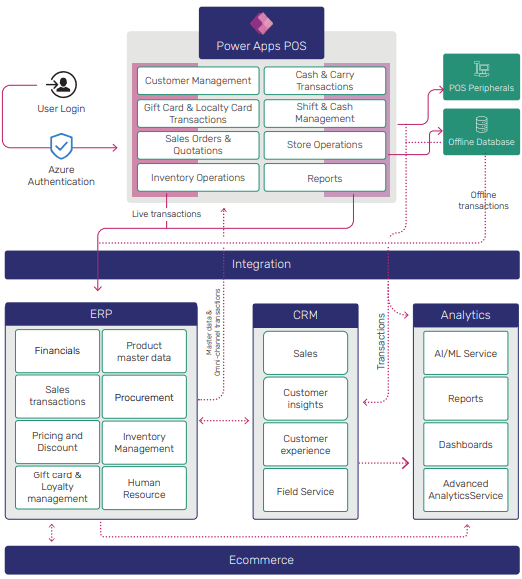
Korcomptenz 20+ years of experience in the Connected Retail market, including in-store and only sales, allowed us to leverage the powerful capabilities of Microsoft Power Apps to build a platform independent, easy to maintain and feature rich Point of Sale solution. Power Apps Point of Sale is intended as a highly scalable option with built in APIs to connect with any application as a backend. It also supports bidirectional communication with a centralized ERP system, and is ready to take up omnichannel business scenarios.
Korcomptenz’ Power Apps Point of Sale is also much easier to deploy and maintain than traditional solutions. Centralized over the air updates ensure your Point of Sale is always running seamlessly and all your stores are using the latest version of the software.
Plus, an intuitive design with a personalized User Interface makes the onboarding process easy with a minimal learning curve for new associates.
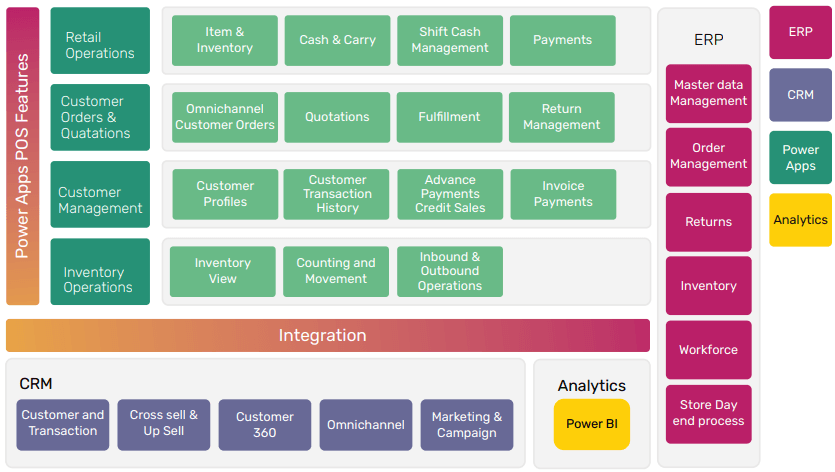
Korcomptenz’ Power Apps Point of Sale comes with approximately 150 features that benefit retailers including:
- Regular cash and carry operations
- Customer management
- Customer order and quotation management
- Shift and cash management
- Store operations
- Inventory operations
- Reporting and analytics
- Omni-channel ready
Backed by Microsoft Azure, this application is also extremely secure and robust, protecting your data and making it easy to upgrade in the future
Understanding the Architecture
Explore the Process and Data Flow
Is Korcomptenz’ Power Apps Point of Sale right for my retail organization?
Korcomptenz’ Power Apps Point of Sale is a lightweight solution suitable for SME retailers. Easy extensibility and upgrades enable businesses to achieve complex scenarios which may required higher degree of customization in traditional POS systems.
As an independent app, the solution is suitable for scenarios like mobile sales, B2B sales where executives visit the customer premise, and other selling situations outside the store. In store, sales representatives can use it at the traditional check out, but also go mobile with handheld devices for a better customer experience. The overall usability is not limited to sales either, but can support additional requirements such as in-store inventory operations, task management, and more.
