.png&w=1920&q=75)





Imagine walking into the hospital of the near future. An intelligent “digital assistant” silently manages routine tasks behind the scenes. It schedules your appointments, alerts your care team to critical lab results, drafts clinical notes, and even nudges patients to take their medications on time, all without human intervention. For busy healthcare executives, agentic AI represents a high return on investment transformation. It’s not just another gadget; it’s a strategic enabler that tackles chronic challenges in efficiency, cost, and patient experience. McKinsey reports that 85% of healthcare leaders are already exploring or adopting AI technologies, signaling a rapid shift from experimentation to enterprise-wide transformation.
In this blog, we tell you how autonomous AI agents are reshaping healthcare, one use case at a time.
Streamlining Operations: Automating the Mundane
Healthcare leaders know that admin costs and paperwork can cripple margins. Here’s where agentic AI shines. Intelligent voice and chat agents automate scheduling and appointment reminders, ensuring that your clinic slots stay full and no-shows drop dramatically. Instead of a staff member calling dozens of patients, an AI agent handles rescheduling and sends confirmations 24/7 via SMS or voice.
The result: smoother calendars and happier patients.
Scheduling and Reminders: AI-driven reminders (via text, email, or call) reduce missed appointments and free up staff time.
Pre-Authorizations: Complex insurance approvals become fast workflows. An AI agent pulls patient data, fills forms, and follows up on authorizations, saving valuable clinician time.
Claims Processing: By validating insurance claims automatically, agentic AI can slash denials and rework, accelerating revenue cycles.
These improvements have a cascading effect. Shortening authorization and scheduling timelines means patients get care faster and providers receive payment sooner.
Once operations are humming, AI’s impact also extends deep into the clinical workflow.
Empowering Clinicians: Smarter Documentation and Decision Support
Imagine a doctor or nurse heading home without being buried in notes. Agentic AI steps in as a virtual scribe. It listens to patient exams or telehealth calls, then automatically documents encounters and populates the EHR. This is more than voice recognition; the AI understands context and asks clinicians quick, clarifying questions if needed. The outcome is concise charts ready for review, no more after-hours typing.
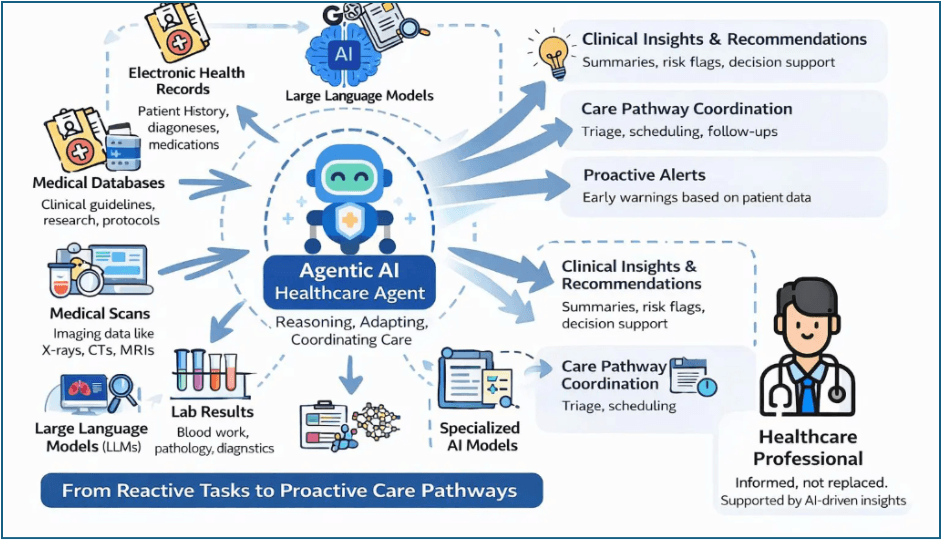
But documentation is just the beginning. Modern agentic systems analyze lab results, imaging, and patient history to boost diagnostics and personalize treatment plans. In practice, this means:
Predictive Diagnostics: By sifting through records and patterns, AI flags early warning signs (for example, predicting risk of sepsis or readmission). This is AI-powered predictive diagnostics that catch problems before they escalate.
Customized Treatments: The same agent can suggest tailored care plans. For instance, it might propose a personalized medication regimen or therapy schedule based on similar patient outcomes.
These capabilities enable smarter decision support, translating into better patient outcomes and higher satisfaction. Clinicians become decision-makers again, guiding and validating AI’s suggestions rather than data-entry clerks.
With clinicians aided by AI, it is now about how patients themselves feel the benefits.
Enhancing Patient Care: Personalized & Proactive Assistance
Enhancing Patient Care: Personalized & Proactive Assistance
Healthcare ultimately revolves around the patient. Agentic AI empowers them in new ways. Here is how:
Continuous Monitoring: Wearables and home devices feed data to AI agents. If a patient’s vitals trend toward trouble, the agent alerts providers or suggests early interventions. This proactive loop can prevent ER visits.
Virtual Health Coaches: Imagine an AI companion that reminds a diabetic patient to check blood sugar, adjusts diet suggestions, and flags warning signs to the care team. These digital health coaches (a form of agentic AI) engage patients daily, boosting adherence to treatment plans.
24/7 Access and Triage: Instead of waiting on hold, patients can interact with AI agents for triage via chatbots or voice. Does chest pain require urgent attention? The AI assesses symptoms and directs the patient to the right care level or schedules an appointment immediately.
All of these are AI-powered healthcare assistance – always-on support that keeps patients connected to care. The net effect?
- More timely care
- Individualized attention
- Enhanced patient outcomes
We’ve seen agentic AI optimize admin work, empower providers, and engage patients. For you, the takeaway is clear: AI agents are no longer sci-fi, but a practical lever for transformation.
Key Takeaways
- Work Smarter, Not Harder: Agentic AI dramatically cuts administrative burdens (scheduling, billing, paperwork) and liberates your staff for higher-value tasks.
- Improve Clinical Impact: By automating documentation and surfacing data-driven insights, agentic AI helps clinicians diagnose faster and personalize treatments.
- Enhance Patient Experience: Virtual AI assistants give patients 24/7 support, from appointment booking to chronic care reminders, making care more convenient and proactive.
- Drive Measurable Value: These use cases translate into real ROI: lower costs, fewer errors, higher throughput, and improved outcomes. Your next-generation care model uses AI to achieve them at scale.
The Future of Healthcare Is Autonomous—Are You Ready?
The journey of healthcare AI is already underway. Leading hospitals and health systems are pilot-testing autonomous agents to stay ahead. Did you know that 64% of organizations report that AI is driving innovation, and 39% are seeing measurable EBIT impact, highlighting the difference between experimentation and enterprise-scale value. As a healthcare leader, you can’t afford to wait. Agentic AI represents both a competitive advantage and a mission-critical tool: it strengthens margins while deepening patient trust.
To leverage these opportunities, start small and strategically. Identify high-volume administrative pain points or patient pathways ripe for AI. Collaborate with experienced AI partners to pilot an agentic solution. Measure the gains in efficiency, satisfaction, and care quality.
Ready to transform your healthcare delivery? Begin by exploring how agentic AI for healthcare can fit into your organization’s vision. Korcomptenz accelerates healthcare transformation by applying agentic AI to enhance diagnostics, personalize treatment, and improve patient outcomes.
Schedule a briefing with our experts today to map out your first use case and take the leap into smarter, more humane healthcare.